
Beauty and the Beast
Details
In Brief
On his way home from the market, the merchant Merkantil notices a fragrant rose bending over the gate of an abandoned castle. He plucks it, and in doing so incurs the wrath of the palace’s owner, the mysterious Beast… What happens next? Who dares to step through the castle gates? And can the spell be broken? Cheerful songs and touching moments await the audience in this playful yet heartfelt story by Péter Tóth and Anna Mechler, first premiered in 2026. The opera, which is not only a fairy tale for children but also a work performed by children, makes is clear that the greatest miracle of all is trust and love.
Parental guidance
Events
Premiere: May 9, 2026
Synopsis
There is great hustle and bustle in Merkantil’s courtyard: the caravan is setting off for the market in Damascus. Carts are being loaded, barrels rolled into place, and the busy household fills the wagons with every earthly delight. Before the long journey, the merchant’s three daughters appear: Magda longs above all for a beautiful silk dress, Léna dreams of a ruby-and-sapphire necklace, while the youngest, Viola, asks only for a single flower as a gift from the fair.
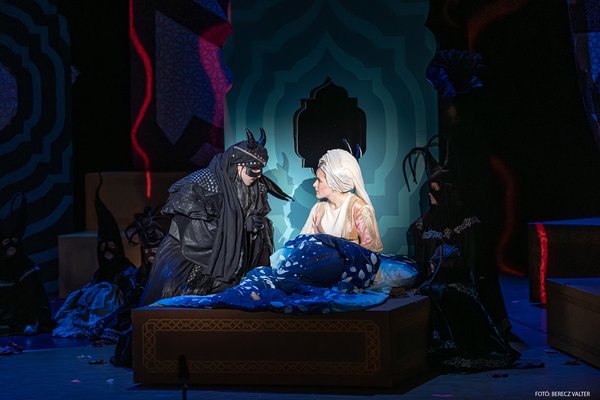
Yet it is precisely this simple request that seems impossible to fulfil. However thoroughly Merkantil searches every merchant’s stall, he cannot find a single flower. Sadly he begins the journey home, when suddenly he notices a fragrant rose arching over the gate of an abandoned castle. Thinking of Viola, he plucks it, only to incur the wrath of the castle’s master. The fearsome Beast, who is in fact the enchanted Prince Belián, offers him a bargain: he will spare the merchant’s life if his youngest daughter agrees to take his place in captivity. With curiosity mingled with fear, Viola crosses the threshold of the castle. Invisible servants immediately surround her, anticipating her every wish: her thirst is quenched with spring water, her hunger eased with fresh fruit… and the Beast himself is not nearly as terrifying as he first appears. During their walks in the garden, Viola discovers that his rough exterior hides a lonely and sensitive soul.
Meanwhile, back at home, Merkantil gathers an army from among his servants to rescue his daughter. They burst into the palace just as Viola softly whispers “yes” to the Beast’s proposal of marriage, breaking the spell at once. Belián regains his human form, while the witches in his attendance vanish into thin air. In the final wedding scene, the family too is reunited, and everyone dances merrily beneath the maypole.
Media
Reviews
“Péter Tóth and Anna Mechler’s collaboration offers us a children’s opera that fulfils every expectation of the genre: expectations that, ideally, should also apply to operas for adults such as never being boring, holding the audience’s attention, avoiding excessive length, and containing memorable melodies. (…) Attila Toronykőy staged the work, whose central protagonist is the Hungarian State Opera the Children’s Chorus in such a way that it recalls The Little Sweep, which he had recently staged. Whether in the movement of the children or in the group choreography, ideas repeatedly emerged that had already proved successful there, and which worked equally well here. And because the dramatic and musical elements of the production came together so effectively, the forty-five minutes of the opera’s running time truly flew by.”
Ferenc László, Új Zenei Újság
Opera guide
“Writing for children perhaps means even more” – an interview with the composer
Although almost everyone knows the story of Beauty and the Beast, the creative duo Péter Tóth and Anna Mechler deliberately depart from the Hollywood gloss. Speaking with the composer, it becomes clear that in their new fairy-tale opera the leading role belongs to children, while the music follows the finest traditions of musical theatre. In connection with the premiere realised as part of the MVM Pikoló Programme at the Eiffel Art Studios, the conversation touched on creative solitude, the secrets of the child’s voice, and why seven-minute arias are not necessary for genuine success.
The story of Beauty and the Beast is enjoying something of a renaissance today. How did this classic tale find its way into your operatic world?
The idea for the piece was born out of the enforced isolation of the pandemic. It may sound strange to say, but for an artist the shutdown brought something that had previously been one of the rarest treasures: time. The composers’ competition at Müpa Budapest also provided a timely opportunity and the final push. Since many in the profession had labelled me primarily as a choral composer, I deliberately wanted to take a different path. I envisioned a children’s production that is accessible yet offers a genuine, uncompromising operatic experience even for the youngest audiences, something that could even reach pupils within the framework of an unconventional singing lesson.
With such a well-known subject, how consciously must one avoid the “Disney effect”?
I deliberately kept my distance from film and other musical stage adaptations. When choosing a subject, many practical considerations come into play: whether contemporary colleagues have written something similar, whether the story can be performed by children, and whether it can be realised economically. I conceived the work for a chamber ensemble of 25 musicians, which lends both mobility and intimacy. Our version follows tradition rather than spectacle. It is thoroughly tonal music, evoking the noble simplicity of Wolfgang Amadeus Mozart, with rapidly shifting keys, classical solos, duets, and large choral scenes.
The central theme of the work is the recognition of inner values. How is this transformation reflected in the music?
This is the most exciting point of the dramaturgy. The Beast’s first appearance is musically deliberately raw, even aggressive, something like a dark Monostatos-type character. As the girl, who is the emotional catalyst of the story, begins to discover something human in him, the musical texture gradually clears and becomes more refined. The orchestration softens, the harmonies open up. I tried to support the inner conflict and the characters’ gradual rapprochement through the arc of the melodic language. The emergence of trust is, in musical terms, also a kind of purification.
Writing an opera for children’s voices and child performers is a discipline in itself. What are its particular rules?
Artistic quality must never be compromised, but practical considerations do need to be kept in mind. Just as one writes differently for trumpet than for violin, the child’s voice also has its own characteristics. One must know the comfortable ranges and rhythmic capacities. The Hungarian State Opera Children’s Chorus is quite extraordinary: their playful naïveté is combined with a level of discipline and professionalism that would do credit even to adult singers.
You conceived the piece as a single, relatively short act. Is this concision aimed at today’s faster-paced generation?
We have to acknowledge that it is more difficult today to hold attention for long periods, but the story itself also demanded this tightness. The narrative is linear and clear, without unnecessary subplots that would justify two acts. I do not favour overextended forms; in this work there are no self-indulgent seven-minute arias during which the audience’s attention might inevitably wander. The scenes are dynamic, and the emotional depth comes from density rather than length.
The premiere takes place at the Eiffel Art Studios, whose somewhat industrial spaces may seem far removed from the intimate world of a fairy tale.
I am a great admirer of classical Baroque opera houses, where even entering the space feels like a ritual, but the Eiffel has its own energy. In truth, any space can be suitable for opera if the production can hold the audience’s gaze on the stage. If a work is dull, attention will wander even in the most gilded box. That is why, together with the director Attila Toronykőy, we have planned a highly visual and dynamic production.
This is not your first collaboration with librettist Anna Mechler. What is your creative process like?
There must be a foundation, the rhythm and meaning of the words, to set my musical imagination in motion. Anna’s lines possess a classical dignity and elegance that immediately established the tone of the work. Of course, there are adjustments along the way, but fundamentally the libretto is what I build the music upon.
It seems that few composers today dare to write operas for the youngest audiences. Do you see your work as filling a gap in the contemporary Hungarian scene?
Indeed, few such works are created, but I do not think this is primarily the composers’ fault. Staging a new opera today involves enormous financial risk and cost, which few theatres are willing to undertake. Many excellent works may lie hidden in drawers simply because there are no resources to bring them to the stage. That is why it is so significant that the Hungarian State Opera provides space for such initiatives. Writing for children may mean even more than writing for adults, because we are responsible for whether the next generation comes to love this genre or remains forever alienated from it.
Where does this work stand within your oeuvre, and what lies ahead?
For me, writing opera is always a “labour of love”. This is my fourth opera, and I experience every premiere as a celebration. At present, I am already immersed in a completely different world: we are creating a comic opera based on Ferenc Molnár’s Play at the Castle, together with Péter Müller Sziámi. It is true that we live in times not particularly conducive to carefree laughter, but I believe that with a humorous, self-ironic work we can bring back a sense of lightness and empathy to the auditorium.
Interview conducted by Máté Ur