
Così fan tutte
Details
In Brief
Così fan tutte is a bewildering piece. With endlessly beautiful music and a comedic guise, Mozart paints the most exquisite yet most embarrassing moments of human emotions and relationships. Have I really fallen in love with my sister’s fiancé? Have I truly stolen my friend’s bride? How is this possible? Is it even possible? Will they forgive me? Can I forgive them? And what happens next? This is the third and final opera Mozart wrote with Lorenzo Da Ponte, following Le nozze di Figaro and Don Giovanni. Premiered on the eve of the composer’s birthday in the penultimate year of his life, the work reflects his complete mastery of opera composition and his deep understanding of the labyrinth of the human soul. It is expressed through arias, duets, and an endless succession of brilliantly comedic large ensembles, where a simple farcical comedy transforms into a chillingly true story. The production is directed by Kriszta Székely, director of the Katona József Theatre, who – following her 2021 staging of Les contes d’Hoffmann at the Erkel Theatre – seeks a fresh, contemporary interpretation of this opera as well. Exploring its deep psychological layers, she brings it closer to today’s audience with the participation of emerging artists in the intimate and modern setting of the Eiffel Art Studios.
The performance is available to watch on OperaVision between 23 May and 23 November 2026.
Parental guidance
Events
Premiere: May 15, 2026
Synopsis
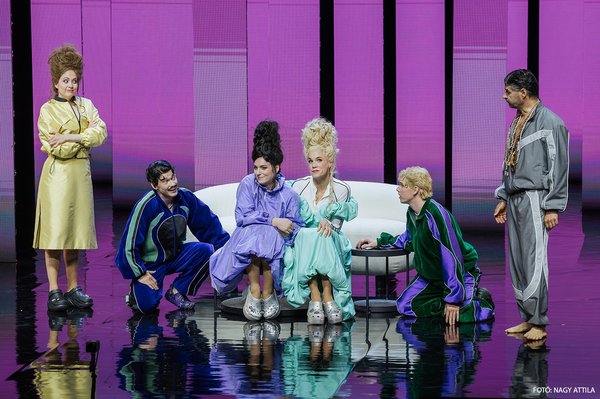
In Così fan tutte, Wolfgang Amadeus Mozart and Lorenzo Da Ponte push the emotional excess, intricate plot, and bittersweet moments of romantic comedy to the extreme. The lovers are forced not only to confront the hidden sides of one another but also to question their own feelings; they cannot escape unscathed from the game orchestrated by Alfonso and Despina. In Kriszta Székely’s production, the uncertainty of modern identity and relationships comes to the fore through a detailed exploration of comic and dramatic situations and character arcs. Layers of illusion and misdirection surround the characters, who move within an overflowing virtual world of beauty and dreamlike imagery where the only certainty is uncertainty.
Act I
Ferrando and Guglielmo are friends, each in love with one of two sisters. Alfonso, older, more experienced, and more disillusioned, warns them not to trust women’s fidelity. The two friends disagree: they are convinced that their fiancées, Fiordiligi and Dorabella, would never betray them. In the heat of the argument, Alfonso proposes a wager: within twenty-four hours, he will prove that Fiordiligi and Dorabella are just as unfaithful as any other women. The friends accept the challenge.
Fiordiligi and Dorabella eagerly await seeing Ferrando and Guglielmo again. Alfonso informs them that their lovers have been called to military service and must leave immediately. The sisters bid a desperate farewell to the two men, who, following Alfonso’s plan, pretend to depart for war.
Left alone, the sisters give themselves over to lovesick sorrow. The cunning Despina cannot console them; instead, she lectures them that faithful men do not exist and suggests they quickly find new lovers.
Alfonso enlists Despina’s help, asking her to assist two “strangers” in getting close to Fiordiligi and Dorabella. Despina promptly arranges matters, and the two attractive suitors appear, showering the women with declarations of love. Fiordiligi firmly rejects them, offering convincing proof of female fidelity. Ferrando and Guglielmo believe they have already won the bet, but Despina comes to Alfonso’s aid with a new idea.
The two “strangers” pretend to poison themselves in despair over rejection, which deeply affects the sisters. Disguised as a doctor, Despina revives the “dying” men, who then resume their pursuit of Fiordiligi and Dorabella.
Act II
The next day, Despina continues instructing Fiordiligi and Dorabella on how confident women behave. Her words take effect: Dorabella confesses to her sister that she is attracted to one of the strangers (in reality Guglielmo, Fiordiligi’s partner), and they agree that a little flirtation can do no harm. When the two men arrive, Dorabella yields, while Fiordiligi still struggles against her desires.
Ferrando reacts with jealous anger but refuses to abandon the wager. Despina praises Dorabella for her actions. Fiordiligi, confused by her emotions, eventually also gives in to temptation, falling for the other “stranger” (in reality Ferrando, Dorabella’s partner). Now Guglielmo, too, feels the pain of the game. Alfonso coolly reminds the two wounded lovers of his earlier claim: all women behave this way.
Events spiral beyond control as the sisters prepare for a double wedding with the strangers. But just before signing the marriage contracts, Ferrando and Guglielmo suddenly “return.” Alfonso reveals the truth and urges the shocked sisters to reconcile with their disappointed lovers. The two couples thus face a shared although somewhat uncertain future happiness.
Media
Opera guide
Introduction
An opera with partner-swapping, not in the spirit of the usual intrigue-driven conventions of Baroque opera seria, but carried out programmatically and consistently, drawing out the emotional and sensual consequences of the exchange. According to contemporary gossip, Così fan tutte, based on a real social incident that supposedly took place in Vienna, went so far in its honesty that it could hardly remain without repercussions. Thus, not only in its own time, in 1792, shortly after the death of Wolfgang Amadeus Mozart was this comic opera branded “the most absurd piece of nonsense in the world,” saved only to some extent by its “brilliant composition,” but even in the 1920s the German archaeologist and philologist Arthur Schurig, who also worked as a Mozart biographer, could write of Così that here the composer was tasked with depicting “Venus vulgivaga, that form of love which gives itself to the first passerby who happens to please it in that very moment.”
Most likely, it is precisely this delicate aspect, cutting to the quick of our shared human nature and playfully exposing our inconstancy, that explains, or perhaps something else entirely, why among the Wolfgang Amadeus Mozart – Lorenzo Da Ponte operas, Così had the most difficult afterlife for a long time. This is well illustrated by the fact that, for example, our Opera House only included the work in its repertoire in 1930, and even in the middle third of the 20th century, conductors and other real or presumed authorities around the world still made substantial cuts to it. Today, of course, all this belongs to the past, largely thanks to our triumphant Enlightenment-mindedness. What is more, we are gradually moving beyond the delighted astonishment of “how modern, how contemporary it is!”, although it is not impossible that opera directors will be the last to do so. In any case, the discomfort had already disappeared in the previous century, along with affected delicacy, and thus we can now more easily become playmates of Mozart (or rather, Mozart and his collaborators). For Così fan tutte is like those old board games from childhood that offered four or five different kinds of entertainment at once: here you find tag, hide-and-seek, teasing games, puzzles, and dressing-up: some played by the characters on stage with one another, and some played by Mozart with us.
Ferenc László
“Do they all do it this way?” – an interview with the director
In mid-May [2026], a contemporary interpretation of Così fan tutte, Wolfgang Amadeus Mozart’s late comic opera, arrives at the Eiffel Art Studios. Kriszta Székely brings the work closer to today’s audience with young singers, unfolding its deep psychological layers.
Mozart is a peak of the operatic repertoire, where the music defines the framework with great precision. As a director, how much freedom do you have?
In places, with careful thought, you can introduce a bit of irony, even put quotation marks around certain moments of the plot, but you must not go completely against the opera. A director who does not sufficiently respect the music will ultimately lose, and this is especially true of Mozart’s works. From a directing perspective, I consider Così fan tutte a hard nut to crack. The main question for me is how we can present the era we want to speak to, how to interpret the “testing” of love and the motif of deception in today’s context, while also capturing more deeply the inner psychological processes of the characters.
In the 19th century, Così fan tutte was considered immoral; it was rarely performed, and later attempts were made to “fix” it with new librettos. How can it speak meaningfully today?
Two things interest me most in this piece. First, I find the identity crisis the characters undergo: constantly swapping personas in front of each other and themselves is very resonant with how the world functions today. The online space provides an excellent platform for this. People go through many different identities over their lives, trying out styles in taste, clothing, and lifestyle. I feel a strong personal connection to this aspect of the story. Secondly, I want to bring in the dating culture typical of the online world. As everything is revealed by the end of the opera and things fall back into place, in real life too we don’t necessarily have to be afraid of learning everything about another person. Sometimes something truly begins between two people precisely when the walls come down.
The opera presents a rather sharp critique of women, which may seem provocative today. What do you want to convey with this story?
From my perspective, the piece is primarily about the instability of the characters’ identities, including both men and women. We should not sharpen the production into a statement that one gender is like this and the other like that. If we formulate criticism, it must apply to both. What I mainly want to talk about is a sense of lostness. I find it particularly exciting how the characters change, not only through their costumes, but internally as well, as they gradually begin to behave differently. And of course, there is that peculiar, somewhat twisted happy ending at the end of the opera, whose meaning is also worth exploring.
Your last opera direction was Les contes d’Hoffmann in 2021 at the Hungarian State Opera. What experiences can you now bring into Così fan tutte?
After every opera production, I promise myself that next time I’ll delve even deeper into the music. I feel that now too, and it will probably always be this way, because one is never satisfied with what one has already achieved. Hoffmann was a different kind of challenge: a large-scale production with many roles and a big chorus. This is a much more intimate, workshop-like process. Alongside the renowned opera singer István Kovács, I’ll be working with young performers, mostly at the start of their careers, which brings a completely different kind of energy.
The atmosphere of the Eiffel Art Studios differs from traditional opera houses. How did this influence your staging?
We moved in the direction of the online world, using large projections to evoke its illusionism and trendiness, almost to the point of exaggeration. We juxtapose everyday existence with that image-based, virtual reality in which we now organize and live our daily lives. This concept fits very well with the raw, industrial space of the Eiffel.
How does age shape the interpretation of this story?
I primarily associate this material with youth and the uncertainty characteristic of that stage of life. At this age, one feels there will always be something better, that anything can still happen. Then suddenly, it seems as though possibilities fade away, and one is left alone. This is where the character of Don Alfonso becomes truly interesting: where he is speaking from, what condition drives him to interfere in these young people’s lives. Is it life experience, or a kind of weariness? Or does he simply want to show them that life is not as simple as they think?
The opera is a special challenge for all soloists, both musically and dramatically. How do you best guide the singers?
Singers often long to meet directors who come from outside musical theatre, because they bring a different formal language. I very much enjoy working with opera singers, they have great stamina and are open-minded. Opera itself is an inherently absurd form, after all: the characters sing throughout. Compared to this, stage presence necessarily demands something different. What excites me most is not duplicating what the music already expresses but rather counterpointing it or placing it in a new context. Essentially, I’m interested in pushing these musical “excesses” in another direction.
Compared to the Katona Theatre, you engage with a different audience here. How does that affect your work?
Contemporary productions are accepted more slowly by Hungarian opera audiences, it takes time. That’s why I find it important that the artistic leadership of the Opera aims to give space at the Eiffel to more experimental productions and creators who did not grow up within the traditional narrative of opera directing. In this sense, this venue gives me greater freedom. I envision a bold, youthful production. With Hoffmann, some people missed a historically authentic approach, but for me those solutions would be too museum-like. Of course, if I am invited somewhere to direct, they probably expect what I represent.
Interview conducted by András Várhegyi
Mozart and Da Ponte’s final opera
After the premieres of Le nozze di Figaro and Don Giovanni, Mozart and Lorenzo Da Ponte were commissioned by Emperor Joseph II to write their third opera. Da Ponte had originally written the libretto for Mozart’s contemporary and rival, Antonio Salieri, who gave up on the project after working on it for a time. The idea for the story came from various sources, including the myth of Cephalus and Procris from Ovid’s Metamorphoses, in which an amorous Athenian prince puts his wife’s fidelity to the test. A parallel to this can also be found in Boccaccio’s collection De claris mulieribus, as well as in one of his novellas from The Decameron: in the ninth story of the second day, Bernabo bets a man from Piacenza that he will not be able to tempt his wife away from him. (One can guess how this worked out.) Striking similarities also exist in Ludovico Ariosto’s poem Orlando furioso and in various works by the French author Marivaux, who was very popular in Vienna at the time, while the precedent of the “switched” lovers also appears in the final act of Pierre Beaumarchais’s play Le Mariage de Figaro. Mozart put aside his well-known aversion to “borrowed material” and lofty verse and gave Da Ponte a free hand to work with. In turn, the librettist could only marvel at the parts where Mozart’s sublime music gave new and more profound meaning to his comedy.
Neither from Mozart’s correspondence nor from Da Ponte’s memoires is it possible to discern much about Così’s origins. Two things are apparent: at the end of December 1789, a small-scale opera rehearsal was held in the presence of Joseph Haydn and his admirer Michael Puchberg, while the first orchestral rehearsal probably took place on 21 January 1790, likewise with Haydn attending. The world premiere was held at Vienna’s Burgtheater on 26 January 1790. The few critics who came for the performance were polite and mostly positive. Count Zinzendorf, a veteran opera aficionado and diarist, thought the music was “charming” and the plot was “entertaining”. E. T. A. Hoffmann had a high opinion of the entertainingly ironic work and deemed it superb overall. The subject of the piece was not particularly disturbing for the Viennese audience of the time; there were no signs of the debates that the work would spawn afterwards. In the 19th and early 20th centuries, the work would be considered either frivolous or immoral, or both, and during this time only abridged, simplified versions were staged. It was only well after World War II that Così fan tutte could take its rightful place in the opera repertoire.
Although it is most often considered a comic opera, the authors thought of it – like the earlier Don Giovanni – as a dramma giocoso – meaning a “playful drama”: somewhere between an opera seria and an opera buffa. The composer used the devices of both genres in order to counterpoint the feelings and reactions of the characters. Dorabella’s first aria from Act 1 ("Smanie implacabili"), is an unmistakable parody of the angry arias from the “serious” operas of the time. Also recalling the opera seria world of the time was Fiordiligi’s rondo from Act 2 ("Per pieta, ben mio"), with the difference that Mozart was here delivering to the audience an extraordinarily frank and emotional aria. The amazing brilliance of the profundity of his music reveals the layers of the seemingly superficial libretto and simple story.
Judit Kenesey