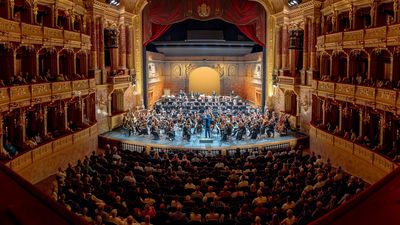
The Hungarian State Opera Orchestra begins its season with a concert marking the 142nd anniversary of the opening of the Opera House, followed a few days later by Mahler’s monumental Symphony No. 8 to mark World Music Day. The Opera142 concert, featuring works by Mahler, Wagner, and György Kurtág, is conducted by principal conductor Martin Rajna on 26 and 27 September, while Mahler’s opus magnum, performed on 1 and 4 October, is conducted by János Kovács, Kossuth Prize-winning eternal member of the Opera. For the first time, both gala programmes is to be performed twice this year at the Opera House.
The Hungarian Royal Opera House opened its doors on 27 September 1884, and the season-opening concert traditionally commemorates this anniversary. The centrepiece of the evening is Mahler’s Symphony No. 1 in D major, ‘Titan’. The work has several connections with the Opera. The composer conducted the first performance of its original five-movement version himself in 1889 at the Pesti Vigadó, leading the Budapest Philharmonic Orchestra, which had been formed from musicians of the Opera House, during his tenure as director of the Opera. Symphony No. 1 already anticipates the composer’s later musical world in every respect: he expands the classical symphonic form with folk-music, song and nature motifs, grotesque irony and extreme emotional contrasts.
Another highlight of the concert is an orchestral compilation from Wagner’s opera Das Rheingold, with which the Opera commemorates the 150th anniversary of the first complete performance of the Ring cycle in Bayreuth in 1876. The work was also first performed at the Opera House in 1889, conducted by Mahler. The excerpts performed tell the story without words: from the primeval Rhine emerging almost from nothing in the prelude, through the majestic music of Valhalla, to Wotan and Loge’s descent into Nibelheim in search of the ring, before proceeding through Donner’s storm and Froh’s radiant rainbow bridge to the gods’ grandiose entrance into Valhalla. The compilation thus traces an arc from the tranquillity of nature through a world of power and possession to apparent triumph, while already containing the shadow of the tragedy that will unfold later in the Ring.
The opening work of the evening is György Kurtág’s Petite musique solennelle, composed as a tribute to his fellow composer and another leading figure in contemporary music, Pierre Boulez, on the occasion of his 90th birthday. With this work, the Opera celebrates the Hungarian composer, who would have turned 100 this year. The Hungarian State Opera Orchestra’s season-opening concert is conducted by Martin Rajna, principal conductor of the Opera, who will take over as Music Director of the Luxembourg Philharmonic from October.
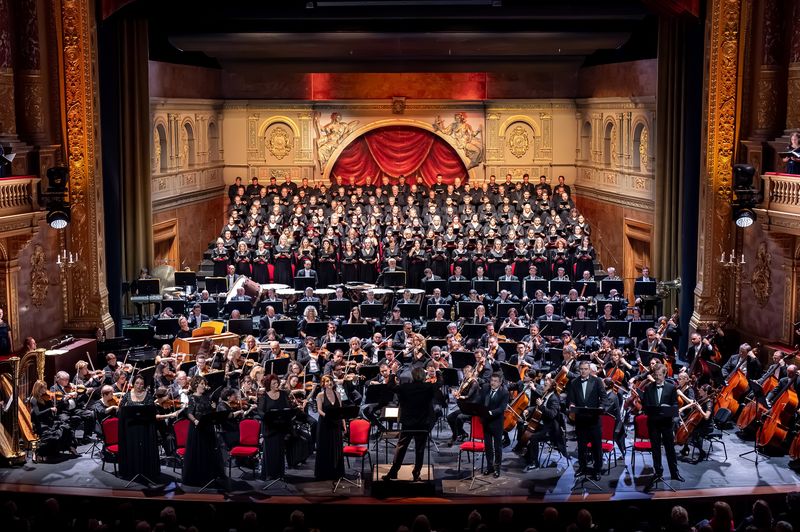
A few days later, the auditorium of the Opera House will once again be filled with the music of one of Mahler’s groundbreaking works. Since 2021, in connection with World Music Day, the Symphony No. 8 has been performed every year on 1 October under the direction of a different conductor; this year, János Kovács, Kossuth Prize-winning eternal member of the Opera, will lead the forces. The two-part composition, through the medieval Latin hymn Veni, Creator Spiritus, praising the creative spirit, and the final scene of Goethe’s Faust, celebrates humanity’s striving towards higher spheres and the power of love and redemption. This monumental work, also known as the ‘Symphony of a Thousand’, calls for an exceptional ensemble, in which the sound of the full symphony orchestra is complemented by eight vocal soloists – this year Zita Szemere, Lilla Horti, Zsuzsanna Kapi, Andrea Szántó, Atala Schöck, Szabolcs Brickner, Csaba Szegedi, and András Palerdi – together with the full chorus and children’s chorus.
Fotó: Berecz Valter
Néhány nappal később ismét Mahler egyik korszakalkotó művének dallamai töltik be az Operaház nézőterét. A zene világnapjához kapcsolódóan 2021 óta minden év október 1-jén más karmester irányításával szólal meg a VIII. szimfónia; idén Kovács János, az Opera Kossuth-díjas örökös tagja áll az együttesek élére. A kétrészes kompozíció a teremtő szellemet dicsőítő középkori latin himnusz, a Veni, Creator Spiritus, valamint Goethe Faustjának zárójelenetén keresztül hirdeti az ember magasabb szférák felé törekvésének igényét, a szeretet és a megváltás erejét. Az „Ezrek szimfóniája” néven is ismert monumentális alkotást kivételes apparátus szólaltatja meg, amelyben a nagyzenekari hangzást nyolc énekes szólista – idén Szemere Zita, Horti Lilla, Kapi Zsuzsanna, Szántó Andrea, Schöck Atala, Brickner Szabolcs, Szegedi Csaba és Palerdi András – a teljes énekkar és a gyermekkar egészíti ki.
Fotó: Berecz Valter