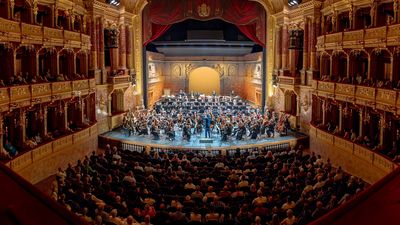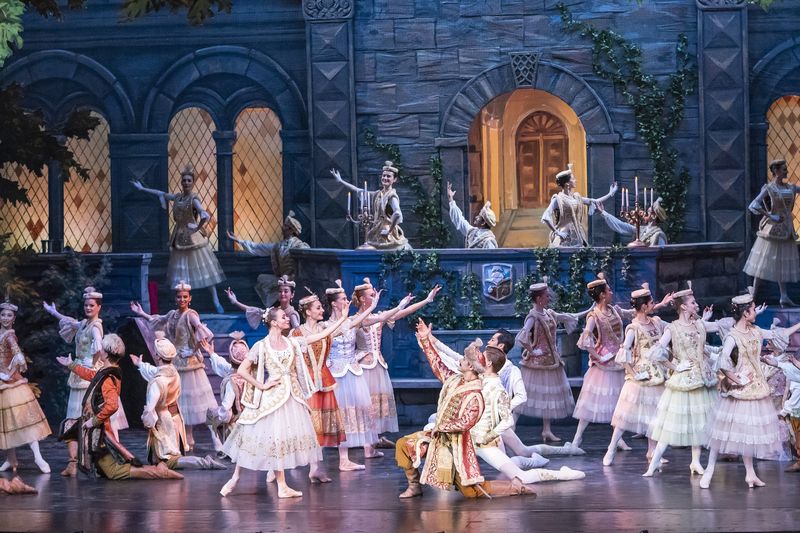
A tale of love, jealousy, and lost happiness is brought to life by the Hungarian National Ballet in their autumn performances of The Fountain of Bakhchisarai. Based on Alexander Pushkin’s poem and set to music by Boris Asafyev, the ballet is performed at the Opera House for the first time after featuring in the programme of the Erkel Theatre for more than seven decades. The ten performances run from 29 October to 15 November 2026. The company presents Rostislav Zakharov’s choreography in a staging by Daria Pavlenko, former prima ballerina of the Mariinsky Ballet in St Petersburg.
Beside the fountain in the palace of Bakhchisarai, a broken man recalls the past. During his campaign in Poland, the Tatar Khan Girey abducted Maria, but neither his power nor his devotion could win her love. Meanwhile, his disfavoured wife, Zarema, desperately fought to regain her husband’s heart. The conflicting desires of three people propel the story towards tragedy, as the classical ballet’s lyrical pas de deux, spirited character dances and spectacular ensemble scenes reveal the characters’ innermost feelings.
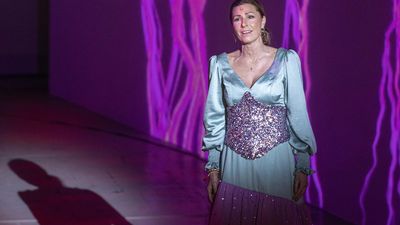
In the multiple casts for the autumn series, Anastasiia Konstantinova and Lee Soobin make their debuts as Maria, beside Lili Felméry and Ellina Pohondih. Maria Yakovleva, Tatyjana Melnyik, Rachel Quintao, and Maria Beck make their company debuts as Zarema, joining Lea Földi, who has previously performed the role. Vladislav Melnyik and Luca Massara make their debuts as Girey, beside Iurii Kekalo and Mikalai Radziush. Viachaslau Hnedchyk, Louis Scrivener, Boris Zhurilov, and Alexander Smith take on the role of Maria’s fiancé, Waclaw, for the first time, beside Gergő Ármin Balázsi. Motomi Kiyota, Vince Topolánszky, and Daniyar Zhumatayev make their debuts in the virtuoso dances of Nurali, the khan’s commander, beside András Rónai. Paul Connelly conducts the Hungarian State Opera Orchestra in the work for the first time, while Sámuel Csaba Tóth returns to the ballet with which he made his conducting debut with the company in 2019.
The ballet master responsible for staging the production, Daria Pavlenko, brings exceptional first-hand experience to the interpretation of the roles. She herself danced both Maria and Zarema at the Mariinsky Theatre in St Petersburg, where the ballet was premiered. A graduate of the Vaganova Academy, she was a member of the company from 1996 to 2018, and her career was recognised with a Special Jury Prize from the Golden Mask Awards in Russia. Apart from the great classical roles, she has performed works by Balanchine, Forsythe, and Ratmansky, and has also been acclaimed by audiences at the Royal Ballet in London as a guest artist.
First performed in 1934, the ballet also occupies a significant place in the history of Hungarian ballet. For the Hungarian premiere in 1952, Zakharov himself supervised the staging at the City Theatre, now the Erkel Theatre, and the work has provided memorable roles for several generations of dancers. In 2018, after a thirteen-year hiatus, the Hungarian National Ballet revived the production. Pavlenko coached a version of the choreography closer to the original, Szilárd Kerekes reconstructed Zoltán Fülöp’s set designs, and Nóra Rományi created the new costumes.
The Fountain of Bakhchisarai is on the Hungarian State Opera’s programme on 29 and 31 October, and 3, 5, 7, 8, 12, 13, and 15 November 2026.
Photo by Valter Berecz