Mozart’s Bastien und Bastienne and Menotti’s The Telephone, two one-act operas from different eras, explore the pitfalls of finding your way to one another. As part of the MVM OperAdventure series, these Hungarian-language productions aimed at schoolchildren are performed four times by Gabriella Rea Fenyvesi, Gergely Halász, Bence Pataki, and Gergely Dargó, with the Hungarian State Opera Orchestra conducted by Nátán Sugár, making his conducting debut with the Opera.
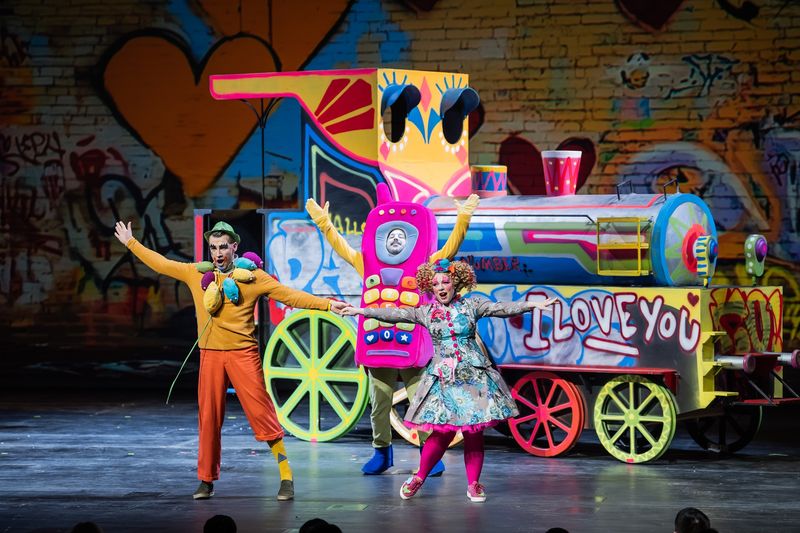
Why does it take a magician for two lovers to understand each other, and why is it easier to say over the phone what we would like to tell someone in person? In Mozart’s opera, composed when he was just 12, Bastienne fears that she has lost her beloved Bastien’s love and turns to Colas, the village fortune-teller. Through jealousy and feigned indifference, he brings the young couple closer together. In Menotti’s 1947 opera, the title character, a telephone, takes the place of the third party who pulls the strings. Ben is desperate to propose to Lucy, but the constantly ringing telephone repeatedly delays the decisive moment, until a clever idea turns it into the key to the solution.
The productions, intended for young audiences and brought to life by young performers, are conducted by Nátán Sugár, who makes his debut at the Opera House at the age of 20. Born in Kuala Lumpur and raised in Vienna, he began studying conducting at the age of 15 and is currently a student at the University of Music and Performing Arts Vienna. He has conducted the MÁV Symphony Orchestra, the Pannon Philharmonic Orchestra, and the Alba Regia Symphony Orchestra. From the 2025/26 season, he has also been working as assistant to Petr Popelka, Chief Conductor of the Vienna Symphony Orchestra. He first became acquainted with the Opera House’s artistic workshops while working alongside First Conductor Martin Rajna on productions of Der fliegende Holländer and Macbeth.
The lovers in the two stories are portrayed by Gabriella Rea Fenyvesi and Gergely Halász, with Bence Pataki as Colas and Gergely Dargó as the Telephone, which becomes a character in its own right on stage. In Andrea Valkai’s production of Mozart’s opera, shadow theatre and animation are also woven into the story, while the Opera House has adapted András Almási-Tóth’s production of Menotti’s work for its forestage. Performed above the raised orchestra pit, both productions bring the action close to the audience, showing how a small misunderstanding can lead to enough complications to fill an entire opera.
As part of the MVM OperAdventure programme, these performances are recommended for children from the early years of primary school onwards. They will take place at the Hungarian State Opera on 8, 22, and 28 November 2026 at 3 pm, and on 14 November at 11 am.
Photo by Valter Berecz