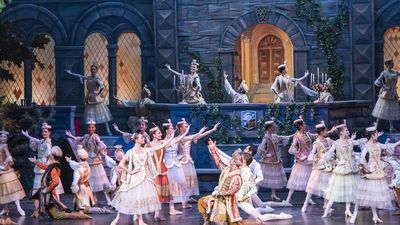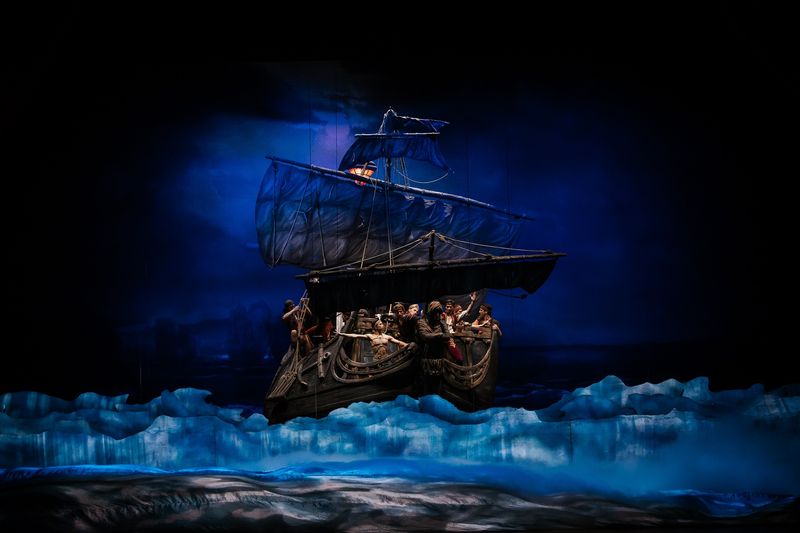
The Hungarian National Ballet brings to life the thrilling world of Lord Byron’s romantic narrative poem in its spectacular classical ballet Le Corsaire. The production by Anna-Marie Holmes and Tamás Solymosi is performed seven times at the Opera House between 25 September and 11 October 2026 as part of the Season of Eastern Tales. The leading roles are performed in four alternating casts by Maria Yakovleva, Tatyana Melnyik, Maria Beck, Soobin Lee, as well as Louis Scrivener, Raffaello Barbieri, Gergő Ármin Balázsi, and Luca Massara.
Lord Byron’s 1814 narrative poem, immensely popular in its day, created one of the emblematic figures of Romanticism in the character of Conrad, the pirate captain. An outlaw with a dark past, proud and solitary, this hero is both dangerous and alluring: a man who refuses to accept society’s rules, yet is prepared to do anything for the woman he loves. When he falls in love at first sight with Medora, a beautiful slave girl in a Turkish bazaar, he defies the local ruler, Pasha Seyd, and his men, enlisting his pirates to rescue her. When Conrad’s companion Birbanto witnesses the captain freeing the captured slave women, he rebels against him. Following the ensuing confrontation, Medora once again falls into the Pasha’s hands. Conrad returns to the Pasha’s palace in disguise, and the two must overcome many more trials before they can finally remain together.
One of the most important starting points for the stage tradition known today was Joseph Mazilier’s production, created for the Paris Opera in 1856. Two years later, Jules Perrot brought the ballet to St Petersburg, after which Marius Petipa revised it on several occasions and added new dances, making a major contribution to the development of the classical version known today. The Hungarian State Opera’s ballet company’s production is based on a work created by Canadian choreographer Anna-Marie Holmes for Boston Ballet in 1997, which also draws extensively on the Russian ballet tradition of the 20th century. In 2017, Holmes worked with ballet director Tamás Solymosi to adapt the choreography specifically for the Hungarian National Ballet, which presented it as an independent production for the first time that year. The ballet’s rich and exotic visual world is completed by István Rózsa’s monumental sets and Nóra Rományi’s wonderful costumes.
Le Corsaire stands out in the repertoire not only for its dramatic plot and spectacular visual elements, but also for the extraordinary demands it places on classical ballet technique. Virtuoso male variations, daring lifts, large-scale ensemble scenes and lyrical pas de deux alternate throughout the performance, while the roles demand a strong stage presence alongside exceptional dance technique. One of the ballet’s best-known passages is the pas de trois performed by Medora, Conrad, and Ali, the slave, whose variations are also regularly performed independently at ballet galas and competitions around the world.
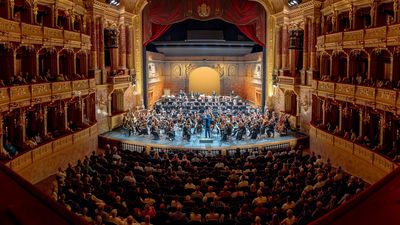
In the autumn series, Medora is performed by Maria Yakovleva, Tatyana Melnyik, Maria Beck, and Soobin Lee, while Conrad is portrayed by Louis Scrivener, Raffaello Barbieri, Gergő Ármin Balázsi, and Luca Massara. Gulnare, the slave girl, is danced by Ellina Pohodnih, Erina Yoshie, Yuki Wakabayashi, and Claudia García Carriera, while the virtuoso role of Ali, the slave, is performed by Motomi Kiyota, András Rónai, Yago Guerra, and Vince Topolánszky. Birbanto is portrayed by Daniyar Zhumatayev, Dumitru Taran, Auguste Marmus, and Vladislav Melnyik. Adolphe Adam’s music is performed by the Hungarian State Opera Orchestra conducted by Paul Connelly and Paul Marsovszky. Students of the Hungarian National Ballet Institute also take part in the performances.
Le Corsaire is presented at the Hungarian State Opera as part of the Season of Eastern Tales on 25, 26 and 29 September, and 2, 4, 9 and 11 October 2026.
Photo by Attila Nagy