Géza, Grand Prince of Hungary, had his firstborn son crowned King of Hungary on Christmas Day of the year 1000 according to the Julian calendar, and on 1 January 1001 according to the Gregorian calendar. To mark the anniversary of this historically significant event, on New Year’s Eve the Hungarian State Opera presents the symphonic version of Stephen, the King, while at the New Year’s concert works by Beethoven and Kodály connected to Saint Stephen I are also to be performed.
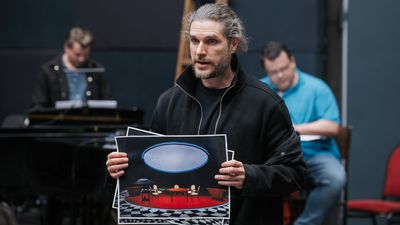
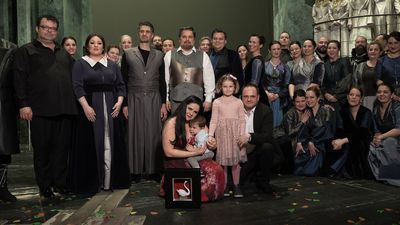
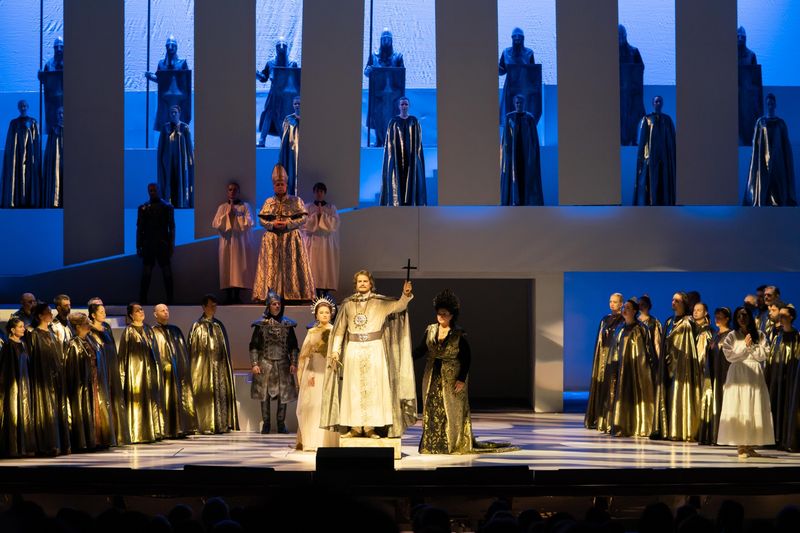
On the occasion of composer Levente Szörényi’s 75th birthday, the Hungarian State Opera presented the symphonic version of the rock opera Stephen, the King in 2020, orchestrated by Levente Gyöngyösi, conducted by Gergely Kesselyák, and directed by Miklós Szinetár. The cult work written jointly with János Bródy bids farewell to the Opera House after nearly 50 highly successful performances, including this year’s series. In the visually striking production, which makes its impact without any electronic amplification, László Boldizsár and Barna Bartos make their debuts as Stephen this year, while Andrea Ulbrich debuts in the role of Sarolt. Other principal roles are performed by Csaba Szegedi (Koppány), Kinga Kriszta (Gizella), Andrea Meláth (Sarolt), János Szemenyei (Laborc), István Kovácsházi (Asztrik), as well as Melinda Heiter and opera studio member Vivienne Ortan (Réka). The production, with the participation of the Hungarian State Opera Orchestra, Chorus, and a 14-member dance ensemble, is once again conducted by Gergely Kesselyák at performances on 31 December and on 3, 4, 9 & 10 January 2026.
New Year’s concert commemorating Saint Stephen
At the Opera House’s New Year’s concert, in addition to Beethoven’s Symphony No. 9, which includes Ode to Joy, the composer’s also popular King Stephen Overture will be performed in honor of the occasion. Beethoven composed the seven-minute work as incidental music to August von Kotzebue’s play King Stephen, the First Benefactor of Hungary, for the opening of the Pest German Theatre, inaugurated in 1812 on today’s Vörösmarty Square in Budapest. This will be followed by Zoltán Kodály’s hymn Song to King Saint Stephen, composed in 1938 for the 1,000th anniversary of the founding king’s death. The five-minute choral work is based on the Catholic folk hymn beginning Ah, where are you, radiant star of the Hungarians, set to Kodály’s own melody. At the New Year’s concert, a ceremonial address is delivered by Tamás Freund, Széchenyi Prize–winning neurobiologist and President of the Hungarian Academy of Sciences, who, together with his wife, are also to take part in the Kodály choral work. At the concert, also scheduled for 17 January 2026, at the Opera House, the Hungarian State Opera Orchestra and Chorus are conducted by Ádám Cser, with soloists of the Ninth Symphony being Lilla Horti, Atala Schöck, István Kovácsházi, and Krisztián Cser.
New recording of Erkel’s opera King Stephen
In February 2026, the OPERA will continue a commitment made a decade and a half ago to record and make publicly available every work by Ferenc Erkel, founding music director of the Hungarian State Opera and creator of Hungarian national opera. In the jubilee year, fittingly, a recording will be made of Erkel’s final opera, King Stephen. Based on Lajos Dobsa’s tragedy King Stephen I, the work addresses the conflicts surrounding the succession of the founding ruler and was composed with the collaboration of the aging composer’s son, Gyula Erkel. The opera was originally commissioned for the opening of the Opera House, but its premiere ultimately took place later, on 14 March 1885, during the theatre’s first season, to great success.
In the recording, Stephen is sung by István Kovács, Gizella by Mária Farkasréti, Prince Imre by Adorján Pataki, Péter Orseolo by Csaba Szegedi, Vazul by Csaba Sándor, and the Croatian princess Crescimira by Kinga Kriszta. They are joined by Csenge Anna Fürjes, Zsuzsanna Kapi, Bence Pataki, Géza Gábor, András Kiss, and Attila Dobák in further roles. The musical realization is directed by István Dénes, eternal member of the Hungarian State Opera, conducting the Hungarian State Opera Orchestra and Chorus. Following post-production, the recording will be available on popular music streaming platforms.
Photo by Valter Berecz